
An SEO guide to audience research and content analysis
In this stage of your SEO research and planning, you’ll want to identify:
- Target personas
- Buying stages
- Potential keywords
Your goal will be to map your target personas, buying stages and keywords for each persona and buying stage.
Map keywords to persona to the buyer’s journey
The goal of this phase is to identify all of the possible ways you can be found and to make sure you have content optimized on your website targeting these buying phases and keywords.
You’ll start by identifying primary, root phrases. As you progress, you can go deeper into long-tail terms or semantically related keywords.
This will allow you to identify gaps and opportunities that were missed during your initial baseline and competitive research. Some of these keywords won’t be uncovered unless you truly understand your audience and their needs and pain points.
This stage will complete your research phase and give you all the information to create your content strategy and focus your on-page SEO priorities.
Evaluate your existing content
With your comprehensive keyword research, the next step is to look at the existing content of your site and see if it’s optimized properly.
- Does your website have pages that are not getting any traffic from Google, pages that are near-duplicates or multiple pages targeting the same keyword?
- Do you have content pieces to match the keyword list you created in the previous stage?
Before creating a content calendar or editorial strategy, it’s ideal to audit your existing content. By reviewing your existing pages, you can decide which pages need to be removed, consolidated or optimized.
Some of the elements you can look for include:
- Page traffic
- Primary keyword
- Number of keywords ranking
- Word count
- Internal linking
To perform a content audit, you’ll need to export all of your pages from your CMS or use an SEO audit tool, such as Screaming Frog or Semrush Site Audit, to get a list of your site’s existing pages.
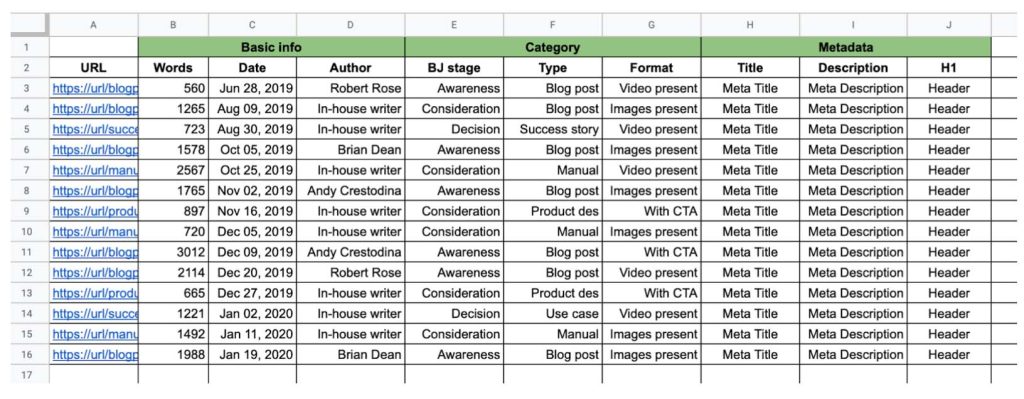
Consolidate all of this data into a content audit spreadsheet. Your spreadsheet could look something like this:
Assess your site’s content
Once you have collected all of the data, go through the URLs and label the pages:
- Keep: The page is optimized and performing well and can be left alone.
- Optimize: The page could be ranking better with improved on-page SEO.
- Rewrite/revamp: This is for pages where the content needs to be revamped or rewritten.
- Remove: These pages are not performing well and should be removed. When doing so, it’s important to remove the page from your sitemap, Google Search Console, and any inbound links.
- Consolidate: If there are multiple pages targeting the same keyword, consider moving all of the content into the URL that is performing best and using 301 redirects for the other pages.
How to optimize, revamp or consolidate pages
Once you have all of your pages labeled, it’s time to optimize your content. Some pages may be performing well but could be refreshed to help them perform even better. Others may be performing poorly and need to be optimized to rank.
Typically, this process will involve two steps:
- Editing and re-optimizing the existing content.
- Expanding the article with new content.
Article Written by Marcela De Vivo